The Druid Priestess, Imposter Syndrome, and the Things We Don't Quite Know How to Explain

Updated: Jul 1
The Things We Don't Quite Know How to Explain
There is a moment that happens in therapy rooms every day.
A client takes a breath and says:
"This is going to sound ridiculous..."
"I've never told anyone this before."
"You'll probably think I'm mad."
And then they tell you.
It might be the dream they can't stop thinking about, or the feeling they can't explain, intuition they ignored, or the sense that something happened which doesn't fit neatly into logic, evidence, or reason.
As therapists, we know these moments matter.
Not because they are objectively true, but because they are psychologically true. They carry meaning and they may tell us something about the person sitting in front of us.
Again and again, I have sat with people as they cautiously shared experiences they could not fully explain, and together we have explored what those experiences might mean.
Recently, however, I found myself unexpectedly on the other side of that conversation.
Over the past few months, I've been developing my sound therapy practice alongside my clinical work as a psychotherapist. Somewhere amongst the crystal singing bowls, nervous system regulation, deep rest, and the ever-healthy dose of curiosity, I have found myself becoming interested in something I have spent most of my professional life treating with caution: intuition.
Not with the intention of abandoning science or replacing evidence with magical thinking. Simply becoming curious about the possibility that human beings might know things in more ways than one.
As that curiosity deepened, I found myself returning to an image that had stayed with me for years.
The Visualisation
Now, I have only shared this previously with a handful of very trusted people so this feels scary as anything to put it all out here. But, deep breath, here goes...
In 2022, I attended my first women's circle, held under a full moon whilst receiving ThetaHealing, a kind of deep meditation. And during this, I had the strongest visualisation.
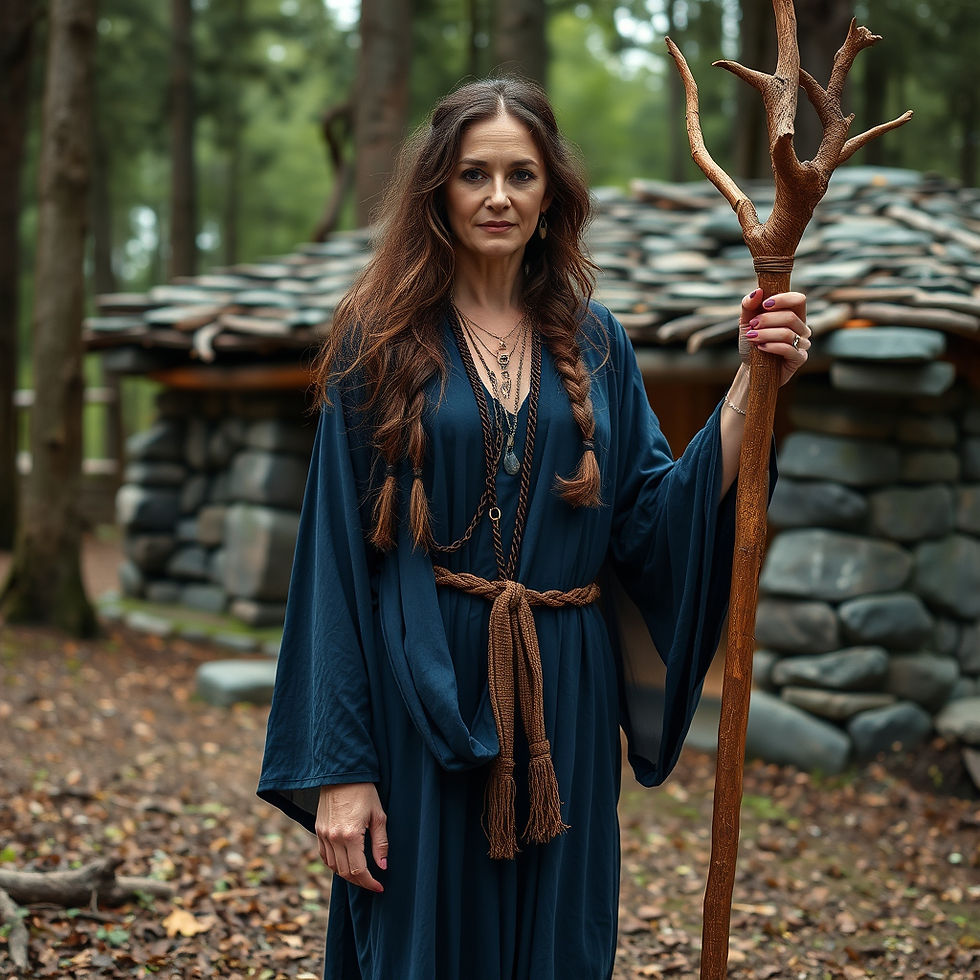
In it, I was some kind of a Druid Priestess.
I can still remember the details with surprising clarity. The jewellery and clothing I wore. The stone structure I entered.
But most vividly, I remember the community that surrounded me. As I entered, they placed a hand on their hearts and bowed.
For a long time, I struggled to understand why this image stayed with me. I mean, it wasn't a fantasy of power, it didn't feel hierarchical, nobody appeared afraid or was worshipping anyone.
So I knew that the feeling wasn't reverence, or obedience. Kind of like it wasn't leadership in the conventional sense.
The closest word I can find is trust.
The community (mainly women) seemed to be saying:
"We know who you are."
"We trust you."
"You/we are safe."
Interestingly, I don't think historical records tell us a huge amount about Druid women. (*Please send me links if you know differently!*) In my very limited research, it appears that most of what we know about Druids comes from Roman writers, whose accounts were often incomplete, biased, or second-hand. Yet there are tantalising references to female spiritual figures in Celtic societies, including prophetesses, healers, and women believed to possess wisdom or divinatory gifts. Whether "Druid Priestesses" existed in the way my modern imagination portrayed her remains uncertain, but the image of wise women serving as guides, keepers of knowledge, and trusted community figures has echoed through Celtic mythology and folklore for centuries.
What interested me most, however, was not the historical question. It was the emotional impact of the image itself, and what it seemed to reveal about my own relationship with trust.
Imposter Syndrome and Trust
As someone who has spent much of her life battling imposter syndrome, this feels deeply significant.
Like many therapists, I am often far more comfortable recognising the strengths, wisdom, and capabilities of other people than I am my own. My internal dialogue is frequently occupied with questioning whether I'm good enough, whether I know enough, if people will 'see through' my multiple degrees, constantly wondering 'what am I missing here?!'
Because if I ever reach a point where I think I've got this therapy thing completely nailed, then it's probably time for me to leave the therapy room.
These questions don't disappear simply because you collect qualifications, experience, or expertise. If anything, they often become more sophisticated.
And perhaps, beneath all of this, there is something about the therapeutic relationship itself. Therapy often asks people to bring forward the parts of themselves they fear will be judged, dismissed, or misunderstood. Over time, healing can emerge not simply from insight, but from the experience of being met with curiosity and steady care. In many ways, trust is the foundation of the work. Not trust that the therapist has all the answers, but trust that difficult experiences can be explored together without shame.
Perhaps that is why the visualisation continued to linger. Not because I secretly believe I was a Druid Priestess in a previous life (although...)
But because something within the image seemed to speak directly to a psychological truth I found harder to access in ordinary language.
To understand that possibility, I found myself turning towards a framework that has long been interested in the language of symbols.
A Jungian Reflection
Carl Jung wrote extensively about archetypes; universal patterns and symbols that emerge across cultures, stories, myths, and dreams. From a Jungian perspective, the Druid Priestess may not represent a literal person at all. She may represent an aspect of the psyche seeking expression.
A wise woman.
A healer.
A guide.
A keeper of knowledge.
Not someone who possesses power over others, but someone who can be trusted.
As a Dramatherapist, I am acutely aware that images, stories, symbols often communicate things that ordinary language cannot. The imagination is not the opposite of truth. Sometimes it is the route through which truth becomes visible.
In Dramatherapy we often talk about the aesthetic distance that metaphor provides. A symbol can reveal something that feels too vulnerable to approach directly.
Perhaps it was easier for my psyche to create a Druid Priestess than to simply tell me:
"You are more capable and trustworthy than you realise."
Perhaps it was easier to show than tell.
Viewed in this way, the image becomes less a claim about what happened and more an invitation to reflect on what it means.
That same willingness to stay with meaning rather than rush towards explanation has continued to appear in unexpected ways.
More recently, during a sound therapy training, a Reiki Master told me she could feel an extraordinary amount of energy when we held hands. The old version of me would probably have dismissed the comment immediately.
The newer version is trying something different. Curiosity. Not certainty or blind belief. Just curiosity.
Embracing Uncertainty
And before any of my fellow sceptics quietly close this browser tab, roll their eyes and mutter, "She's finally lost it," I should say that I understand.
Part of me is sitting right there beside you.
The psychotherapist.
The clinician.
The evidence-lover.
The part that wants things measured, operationalised, and replicated before drawing conclusions.
I haven't abandoned her.
If anything, she's one of the reasons I feel able to approach these experiences with curiosity rather than unquestioning belief.
What I find increasingly difficult to dismiss, however, is the simple fact that the universe is already far stranger than we often allow ourselves to acknowledge.
From a scientific perspective, we know that matter and energy are intimately connected. We know that every atom in our bodies was forged in stars that existed long before we did. We know that sound is vibration, that the nervous system communicates through electrical impulses, and that human beings are constantly influencing one another through subtle processes of attunement and co-regulation.
None of it proves that a Druid Priestess appeared to me in a visualisation for reasons beyond the workings of my own psyche. But it does remind me that reality is already astonishing.
Sometimes I wonder whether the mistake is assuming we must choose between science and wonder. Between evidence and imagination. Between psychology and mystery.
The longer I work as a therapist, the less interested I become in certainty and the more interested I become in holding multiple possibilities at once.
Perhaps intuition is a sophisticated pattern-recognition system, something spiritual, or some combination of the two.
Perhaps archetypes emerge from the collective unconscious in ways we are only beginning to understand.
Perhaps some experiences are symbolic rather than literal, yet no less meaningful for it.
Or perhaps there are aspects of being human that remain beyond our current ability to explain.
I don't know.
And, increasingly, I find that a rather freeing place to stand. And that ultimately brings me back to where this reflection began: the things we don't quite know how to explain.
And there may be aspects of experience that are carried in ways we do not yet fully understand. We know trauma can live in the body long after conscious memory fades. We know patterns can echo across generations. Sometimes I find myself wondering whether our DNA remembers things that our brains cannot.
And perhaps that's the point.
As therapists, we spend our lives helping people tolerate uncertainty. Helping them sit alongside complexity and maybe resist the urge to rush towards simple answers.
Maybe we owe ourselves the same courtesy.
The greatest shift for me has not been in what I believe. It has been in what I am willing to wonder.
And perhaps that is where growth often begins. Not with certainty, or expertise, or with knowing.
But with the courage to say:
"This might sound ridiculous, but..."
And trusting that what emerges next deserves to be listened to. Even if we don't fully understand it yet.


Comments